
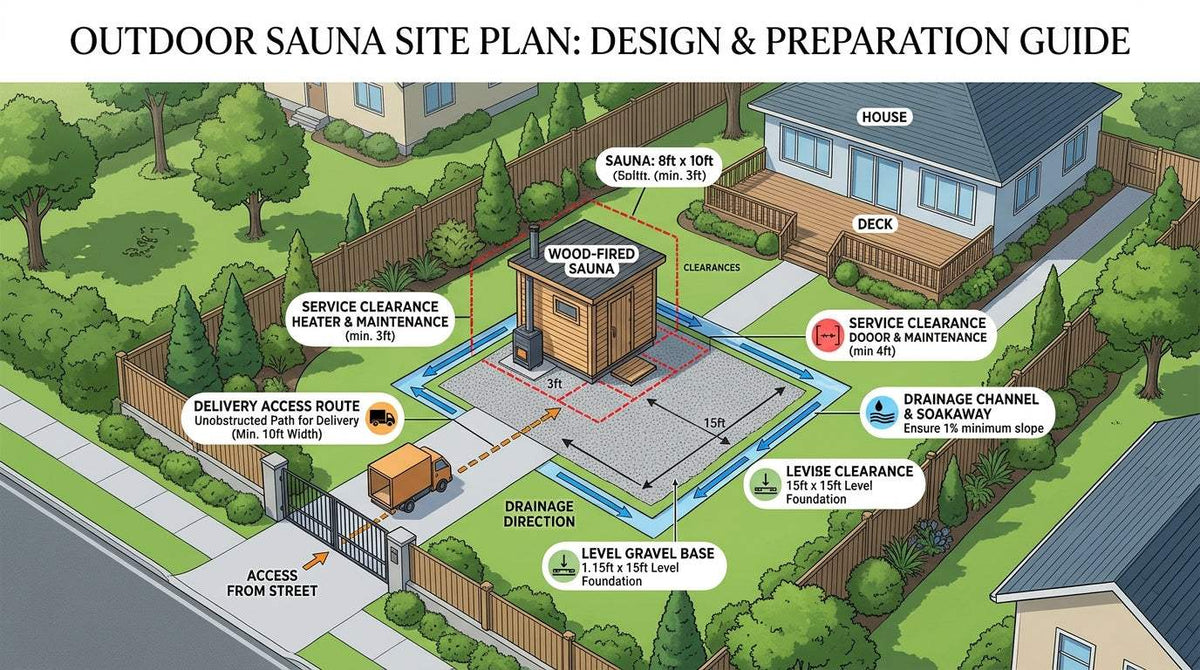
How to Choose the Right Sauna Heater Size
Shopping for an electric sauna heater can feel like a numbers game. One model lists its power in kilowatts (kW), another gives a room-volume range, and your sauna may have a glass door that complicates the comparison. The good news: you can narrow the options without guessing.
This guide walks U.S. homeowners through measuring a sauna, accounting for surfaces that heater manufacturers treat differently, and comparing models using their published instructions. The key is to choose a sauna heater size for your particular room—not simply to pick a kW number that sounds about right.
Start with your sauna’s room volume
Measure the interior length, width, and height in feet. Then multiply those three numbers to find the room volume in cubic feet:
Length × width × height = room volume in cubic feet
Measure the space the heater will serve, rather than relying on the sauna’s exterior dimensions or a kit’s marketing name. If the ceiling slopes or the room has an unusual shape, divide it into simple sections, calculate each section, and add the results. Keep your notes: you’ll want the same measurements when comparing heater manuals.
For example, a sauna that measures 6 feet long, 5 feet wide, and 7 feet high has a basic room volume of 210 cubic feet. That is your starting point, not necessarily the final figure a manufacturer wants you to use.
Check how the manufacturer treats glass and uninsulated surfaces
Many electric-heater sizing instructions ask buyers to adjust their calculated room volume when the sauna includes glass, masonry, tile, or other surfaces identified in that manufacturer’s guidance. A glass door or a large window may therefore affect which model falls within the stated room-volume range.
Don’t apply a universal glass-door allowance or borrow a formula from a different brand. Manufacturers may define the adjustment differently, specify which surfaces count, or present their sizing guidance in another format entirely. For each heater you’re considering, look up its current installation or owner’s manual and follow that model’s method.
Make a quick list of the room’s relevant features before you shop: glass doors, windows, exposed masonry, tile, and areas that lack insulation. Record approximate surface measurements if the manual asks for them. If you’re unsure whether a particular wall counts, ask the manufacturer or dealer how to apply that model’s published instructions.
An illustrative sizing comparison
Return to the 6-by-5-by-7-foot sauna: its measured volume is 210 cubic feet. Imagine it also has a glass door. You find two electric heaters whose published room-volume ranges include 210 cubic feet, but their instructions handle glass differently.
Rather than selecting either heater immediately, work through each model’s manual separately. Apply its stated glass adjustment, if one is required, and compare the resulting figure with that same model’s recommended room-volume range. You might find that one remains within range while the other calls for a different model. This is an illustration of the comparison process, not a claim about any particular heater or a substitute for its manual.
Compare heaters by their published ranges, not kW alone
A heater’s kW rating is useful, but it is not a stand-alone room-size recommendation. When browsing an Electric Sauna Heaters collection, shortlist models by the room-volume ranges published for those specific models. Then check the latest manual for each candidate before making a final selection.
Pay attention to the limits as well as the range. Is your adjusted volume near the bottom, middle, or top of the manufacturer’s stated range? If it falls outside, look at another model rather than assuming a close-enough match. If two candidates both qualify, compare the details that matter to your planned setup, such as controls, placement options, and stated installation requirements.
A broader heater guide can help you organize those feature comparisons. Treat it as a shopping companion; for model-specific sizing and installation details, use the selected heater’s current documentation.
Keep heater sizing and circuit sizing separate
Here’s a distinction worth making before you order: heater sizing asks whether a model’s published room-volume range fits your sauna after any required adjustments. Circuit sizing concerns the electrical requirements for the particular heater and the conditions of your installation. They are related decisions, but they are not the same calculation.
Do not infer a circuit size from room volume, a heater’s kW rating alone, or a rule of thumb found in a shopping article. Instead, provide the exact model’s current manual and specification information to a qualified electrician, who can assess the proposed installation under applicable requirements. That approach also gives you a chance to address electrical questions before committing to a model.
Use this buyer checklist before you choose
- Measure the interior: Write down length, width, and height in feet.
- Calculate basic volume: Multiply the dimensions and record the result in cubic feet.
- List notable surfaces: Note glass, masonry, tile, and any uninsulated areas the manufacturer may ask about.
- Shortlist specific models: Compare their published room-volume ranges, not just their kW ratings.
- Read each current manual: Apply that model’s instructions for surface adjustments and confirm your result falls within its stated range.
- Confirm the exact model: Check the manual’s model designation against the product you intend to purchase.
- Review the installation plan: Share the selected model’s documentation with a qualified electrician for circuit-related questions; don’t use sauna volume as a wiring guide.
- Resolve uncertainties: Ask the manufacturer or dealer about any ambiguous sizing instructions before ordering.
Make the final call with the current manual
Once you’ve picked a model, return to its current manual for the final comparison: your measured room volume, any manufacturer-required adjustments, and the model’s published room-volume range. Manual citation for publication: current manual for the selected heater (insert manufacturer, exact model, and manual revision or date). Replace this link and description with the actual document after selecting the heater; no specific model has been selected in this general guide.
That last check is what turns a rough estimate into a model-specific decision. Measure first, follow the manufacturer’s adjustment method, and keep the electrical review separate. You’ll have a clearer shortlist—and better questions to ask before you buy.


Leave a comment
This site is protected by hCaptcha and the hCaptcha Privacy Policy and Terms of Service apply.