
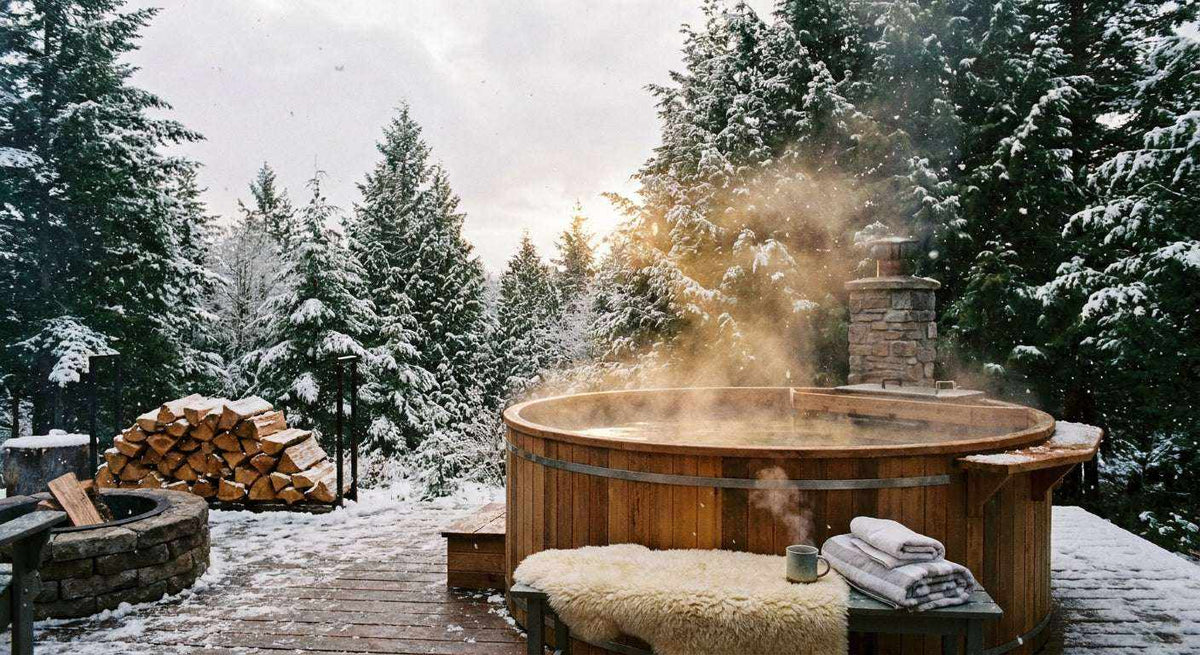
Can You Use a Wood-Fired Hot Tub in Winter?
By: Reid Hollis
Yes, You Can — But Winter Use Requires a Plan
Soaking outdoors while snow falls around you is not only possible — it's the whole point of owning a wood-fired tub for many owners. But there is no single universal rule for winter operation. The right approach depends on your specific model, stove design, local freeze conditions, and how often you plan to soak.
There's also a strong wellness case for making winter your primary soaking season. A 2025 University of Oregon study published in the American Journal of Physiology found that hot water immersion was the only heat therapy method that stimulated an immune cell response lasting up to 48 hours post-session, outperforming both traditional and infrared saunas.
North America accounts for roughly 30% of the global wood-fired hot tub market, according to Archive Market Research, driven largely by outdoor living culture in cold-climate regions. Wood-fired tubs were built for winter.
This article is a cold-weather planning guide for U.S. homeowners. It covers firewood, cover use, drainage, stove protection, and connected lines. It is not a one-size-fits-all prescription. Your model's owner manual is always the authoritative source for your specific tub.
Drain After Every Use or Keep It Filled? It Depends on Your Model
The "drain vs. keep filled" debate you'll find across forums and blogs is a false binary. The correct answer is model-specific and must come from the manufacturer's manual, not from general internet guides.
For the SaunaLife S6B, the answer is unambiguous. The official S6B installation manual states: "In winter, always drain the water from the tub and stove after use to prevent freezing." It further warns that "Water freezing may cause the hot tub or stove to break." After draining, the drain valve must be left fully open, not just cracked.
Here's the detail most guides miss: the stove itself must be drained in winter, not just the tub shell. Water sitting inside the stove compartment is just as vulnerable to freeze damage as water in the basin.
There is also a critical safety sequence to follow. Never drain the tub until the stove's embers are completely extinguished. Draining water away from a hot stove is a safety violation. Wait until the fire is fully out, then drain.
Tub material matters here, too. Fiberglass-lined tubs like the SaunaLife S6B behave differently from all-wood cedar or aluminum tubs during freeze-thaw cycles. The shell material affects how the tub expands and contracts, and how vulnerable it is to cracking. This nuance is rarely addressed in general winter-use guides.
These instructions apply specifically to the SaunaLife S6B 7-Person Black 436 Gal. Other models in the hot tubs collection may have different manufacturer guidance. Always confirm with the documentation that shipped with your tub.
Firewood Storage: The Cold-Weather Variable Most Owners Overlook
Firewood stored outdoors in winter absorbs moisture from snow, rain, and ground contact. Once moisture content climbs above 20%, burning efficiency drops noticeably. According to EPA guidelines, optimal firewood moisture content is 15–20%, and every 1% above 20% reduces effective heat output.
Wet or green wood produces more smoke, leaves residue in the firebox, and makes cold-weather heat-up slower and less reliable. Dry, seasoned wood must be stored under cover close to the tub, not in an open pile exposed to the elements.
The SaunaLife S6B has specific fuel requirements worth noting: dry wood only (no carbon or charcoal), logs no longer than 13–16 inches, started with pellet fuel starter or lighter fluid. Never use paper to start the fire; it throws sparks and embers.
This is the fundamental difference between wood-fired and electric hot tubs. Winter soaking with a wood-fired tub rewards owners who prepare their fuel supply in advance. If you treat it like an always-on electric spa, you'll be frustrated. Plan ahead, and the experience is worth every bit of effort.
Protecting Your Tub, Stove, and Connected Lines Between Uses
Standing water in the tub, stove, or any connected fittings can freeze and cause damage. This is the core winter risk for wood-fired tubs, and it extends beyond the basin itself.
One step that's rarely emphasized: disconnect and fully drain any garden hose or fill line used to fill the tub after each winter fill. A frozen hose connected to a spigot can crack the fitting on the tub side, the hose bib, or both.
For tubs kept filled between frequent uses (where the model's manual permits this), a well-insulated cover makes a significant difference. According to AlumiTubs, a quality insulated cover limits heat loss to approximately 2–3°F overnight, compared to 10°F or more for poorly insulated models. Water temperature in a well-covered tub typically drops no more than 15–18°F per day even in very cold conditions, though this varies by tub design and insulation quality.
If you're considering another model, the SaunaLife S6N 7-Person Outdoor Wood-Burning Hot Tub is also in our collection. Buyers should confirm model-specific winter storage instructions before ordering.
One advantage wood-fired tubs hold over electric spas: there is no internal plumbing, pumps, or jets to blow out, which simplifies winter shutdown considerably. But the stove and fittings still require attention.
Keep winterization (freeze protection) separate from routine cleaning and maintenance. SaunaLife instructs owners to wash the tub after each use and never use chlorine-containing detergents or abrasive cleaners. Wood parts such as walls and stairs should be treated with exterior-grade wood oil at least once a year. That's a routine maintenance step, not a winterization task.
Safe Heating in Cold Weather: What to Check Before Every Soak
Before lighting the stove, the SaunaLife S6B must be filled to approximately 4 inches above the stove section, which is roughly 6 inches from the top rim. Firing the stove before the tub is filled with water is a safety violation. This applies in every season.
The S6B's cold-weather performance is notable. Its dual stainless-steel corrugated heater compartments with a secondary chamber heat 436 gallons from 40°F to 95°F in 1.5 to 2 hours, which is among the fastest heat-up times for a wood-burning tub. SaunaLife rates this stove design at up to 50% less wood consumption compared to standard wood-fired tubs, heating in roughly one-third the time of traditional models. In winter, when efficiency matters most, that difference is meaningful.
For buyers considering smaller formats for cold-water contrast therapy alongside a hot soak, the SaunaLife S2B 2-Person Cold Plunge and the SaunaLife S1B 1-Person Cold Plunge & Hot Immersion Tub are compact options in the collection worth exploring.
Wood-fired tubs require no electricity to heat. During winter power outages, a growing concern for homeowners in cold-climate U.S. regions, a wood-fired tub keeps working when electric spas go cold.
One placement detail that affects safe winter operation: the S6B must be positioned at least 13 feet from any building and leveled with a liquid level on the rim. These decisions are made at installation, but they directly affect how safely you operate the tub through winter.
One Planning Step Most Guides Skip: Check Local Burning Ordinances
Some U.S. municipalities restrict outdoor wood burning, and those restrictions can directly affect whether a wood-fired hot tub can legally be operated in winter. Air quality regulations, HOA rules, or seasonal burn bans may apply in your area even if wood-fired tubs are otherwise permitted.
This is a pre-purchase planning step, not just a post-purchase consideration. Check your local ordinances before ordering. For buyers whose local regulations or space constraints require a smaller or differently configured setup, the SaunaLife S2N 2-Person Cold Plunge & Hot Immersion Tub is another format in our collection worth considering.
Helping buyers ask the right questions before they order, not after, is central to how we operate at Sauna Luxuries. It's the consumer-first philosophy founder Reid Hollis built this company on.
Winter Is When a Wood-Fired Hot Tub Earns Its Place
The answer is yes: wood-fired hot tubs can absolutely be used through North American winters. Wood-fired tubs have been tested in ambient conditions as cold as -44°C (-47°F) and still reached soaking temperature. Cold air alone does not prevent a wood-fired stove from doing its job.
The planning framework is straightforward. Know your model's manual. Store dry firewood under cover. Protect the stove and fittings from standing water. Use an insulated cover between sessions. And check your local ordinances before you buy.
For the SaunaLife S6B specifically, the manufacturer's instruction is clear: drain after every use in winter. If you own a different model, consult your own manufacturer documentation. We encourage you to explore the full hot tubs collection and reach out with any pre-purchase questions about model-specific winter setup. As an authorized retailer sourcing directly from manufacturer channels, we're here to help you get the details right before your tub arrives.
The experience itself makes the planning worthwhile. The contrast of hot water immersion in cold outdoor air, backed by the University of Oregon's 2025 research on immune response, makes winter the season many owners look forward to most.
Sources

Written by Reid Hollis



Leave a comment
This site is protected by hCaptcha and the hCaptcha Privacy Policy and Terms of Service apply.