
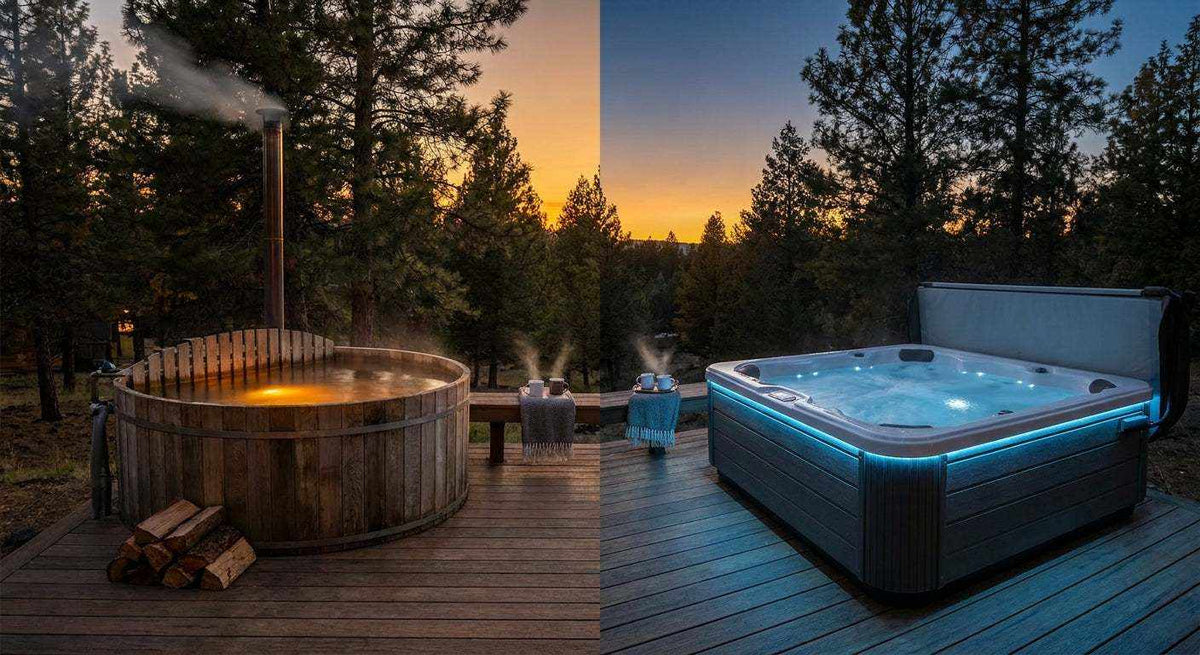
Wood-Fired vs. Electric Hot Tub: Which One Fits Your Home?
By: Reid Hollis
Two Very Different Ownership Experiences
There is no universal winner between a wood-fired hot tub and an electric hot tub. The right choice depends entirely on how you live, where your property sits, and how you plan to use the tub week after week.
The most practical distinction is straightforward: one type requires a licensed electrician, a dedicated 240V circuit, and a permit. The other needs a flat outdoor surface, a garden hose, and dry firewood.
This article compares both types honestly across setup, heat-up time, electrical requirements, ongoing inputs, and maintenance. We won't declare a verdict. A note on transparency: Sauna Luxuries currently carries wood-fired models and does not sell electric hot tubs. We're disclosing that upfront so you can weigh our guidance accordingly.
Setup and Placement: Where Can Each Type Go?
Wood-fired hot tubs require no electrical connection whatsoever. That means they can be placed virtually anywhere outdoors: a remote cabin, an off-grid property, a far corner of a large yard, or a spot 200 feet from the nearest electrical panel. If you have a level surface and access to water, you can put a wood-fired tub there.
Electric hot tubs are different. They must be installed within reach of a dedicated 240V, 50 to 60 amp hardwired GFCI-protected circuit, as required by NEC 2023 Article 680. Placement is therefore constrained by proximity to the electrical panel, or by the cost of extending wiring across your property.
Wood-fired tubs cannot be used indoors due to smoke and ventilation requirements. If indoor installation is your goal, electric is the only viable option.
Placement flexibility is a genuine, underappreciated differentiator. Buyers with irregularly shaped yards, outbuildings, or rural properties benefit most from the freedom wood-fired models offer. The SaunaLife S6B 7-Person and SaunaLife S6N 7-Person are larger-capacity wood-fired models designed for outdoor placement with no electrical hookup required.
Electrical Requirements and Installation Costs for Electric Hot Tubs
Most full-size electric hot tubs require a dedicated 240V, 50 to 60 amp hardwired GFCI-protected circuit professionally installed by a licensed electrician. According to Angi's 2026 Hot Tub Electrical Installation Cost Guide, this is a code requirement, not an optional upgrade.
Electrical installation for a new 240V circuit typically costs $800 to $2,500 for a straightforward run. When panel upgrades, trenching, or long wire runs are needed, costs can reach $1,800 to $7,000, according to HomeGuide's 2026 cost data.
Electrical permits are required in virtually every U.S. jurisdiction and typically add $50 to $500 to the project cost, depending on your municipality and the complexity of the work, per Permit Rules.
Total installed costs for an electric hot tub, including the tub itself, electrical work, a concrete pad, delivery, and permits, can run $4,000 to $15,000 above the purchase price of the tub. Wood-fired hot tubs carry none of these electrical costs or permitting requirements, which meaningfully changes the total cost of ownership comparison.
Heat-Up Time and Ready-When-You-Want-It Expectations
Electric hot tubs maintain temperature continuously. You set your desired temperature, and the tub keeps the water there around the clock, ready whenever you are. That makes electric well-suited to spontaneous, daily soakers who want to step in without any preparation.
Wood-fired hot tubs require planning ahead. The fire must be lit and the water heated before each soak. For some buyers, this is part of the ritual: lighting the fire, watching the temperature climb, settling into an intentional experience. For others, it's an inconvenience.
Per manufacturer specifications, the SaunaLife S4B heats 304 gallons from 40°F to 95°F in approximately 1.5 to 2 hours. Its dual-chamber stove captures heat from smoke and reduces wood consumption by up to 50% compared to traditional models, according to SaunaLife product specifications.
A caveat worth noting: actual heat-up time for any wood-fired tub varies based on starting water temperature, ambient air temperature, wood quality (seasoned hardwood versus green or softwood), and tub size. Evaluate any manufacturer's heating claims against these variables.
Electric hot tubs heat at approximately 3 to 6°F per hour from cold, according to Peak Primal Wellness. They heat slowly if allowed to cool completely, but maintain temperature automatically once set. Usage frequency and routine should drive this decision: planned weekly ritual users and spontaneous daily soakers have fundamentally different needs.
Ongoing Inputs: Firewood vs. Electricity
Wood-fired tubs run on firewood. Seasoned hardwood burns hotter and more efficiently; wet or soft wood burns cooler and extends heat-up time. Wood quality directly affects the experience, so sourcing good firewood matters.
Electric hot tubs consume approximately 3 to 7.5 kWh per day depending on model, climate, and usage. At the 2025 national average rate of roughly $0.17 to $0.18 per kWh, per EcoThrift Home (citing EIA data), that translates to roughly $25 to $100 per month for most households. Optimized operation (lower setpoint, quality insulating cover, timer scheduling) can reduce monthly costs meaningfully, but the ongoing expense is continuous regardless of how often you actually soak.
Wood-fired tubs have no monthly electricity cost for heating. The ongoing input is firewood, which varies by region and usage but is a finite, controllable cost per session. The SaunaLife S2B 2-Person Cold Plunge and SaunaLife S1B 1-Person Cold Plunge & Hot Immersion Tub are smaller-footprint wood-fired options with proportionally lower firewood demands per session.
Water Care and Maintenance: What Each Type Actually Requires
This is where the two types diverge sharply, and it's a point most comparison articles gloss over.
Wood-fired hot tubs without filtration can be operated on a fresh-fill/drain approach: fill, heat, soak, drain. This requires no chemical treatment at all. For buyers who dislike managing water chemistry, that is a genuine lifestyle simplifier. If you prefer to keep water between sessions, pH should be maintained between 7.2 and 7.8, with water changed every 4 to 8 weeks under regular use, per The Log Company. With filtration and sanitizer, water can last 2 to 4 weeks between changes.
Electric hot tubs require ongoing water chemistry management: testing 2 to 3 times per week, maintaining free chlorine or bromine at 3 to 5 ppm, pH between 7.2 and 7.6, and total alkalinity between 80 and 120 ppm. Add monthly filter rinses, quarterly chemical soaks, and water changes every 3 to 4 months, per Hot Tubs Price.
Filter maintenance for electric tubs includes rinsing monthly, soaking in chemical cleaner quarterly, and replacing filters annually or every 12 to 18 months. It's an ongoing time and cost commitment that should factor into your decision.
The SaunaLife S2N 2-Person Cold Plunge & Hot Immersion Tub is a compact wood-fired option suited to buyers who prefer the simplicity of the fresh-fill/drain approach with minimal chemical involvement.
Which Type Fits Your Life? A Buyer-Profile Framework
Spontaneous daily soakers who want the tub ready at any hour without preparation are better served by an electric hot tub. The set-and-forget temperature maintenance matches that routine precisely.
Planned weekly ritual users who enjoy lighting a fire, the anticipation of the heat-up, and the intentional nature of the soak are natural fits for a wood-fired tub.
Off-grid property owners, cabin buyers, and rural homeowners benefit most from wood-fired models that require no electrician, no permit, and no panel evaluation. If your property makes a 240V circuit impractical or expensive, wood-fired solves that problem entirely.
Buyers prioritizing water care simplicity, particularly those who prefer not to manage ongoing chemical regimens, will find the fresh-fill/drain approach of a wood-fired tub a meaningful quality-of-life advantage.
Indoor installation is the one scenario where electric is the only viable option. Wood-fired tubs are exclusively for outdoor use.
Sauna Luxuries carries the SaunaLife S4B and a curated range of models in the Wood Burning Hot Tub collection for buyers whose lifestyle aligns with the wood-fired experience. For buyers whose needs point to electric, we're happy to offer honest guidance even though electric models are outside our current catalog.
Making a Confident Decision
The right choice is the one that fits how you actually live: your usage routine, your property, your tolerance for planning, and your preference for simplicity versus spontaneity. Neither type is universally better.
Keep the total cost of ownership in view. Electric hot tubs carry real upfront electrical installation costs ($800 to $7,000 or more) and ongoing monthly electricity expenses of $25 to $100. Wood-fired tubs trade those for firewood and a more intentional usage rhythm.
If you're still weighing the decision, reach out to us. Our team can walk through your property setup, household size, and usage habits to help you figure out which direction makes sense. No pressure, just guidance. And if wood-fired is where you land, the SaunaLife collection is a good starting point; we can help match the right model to your specific situation.
Sources
- Jacuzzi — Hot Tub Wiring & Electrical (NEC 2023 Article 680)
- Angi — 2026 Hot Tub Electrical Installation Cost Guide
- HomeGuide — Hot Tub Installation Cost (2026)
- Permit Rules — Do You Need a Permit for a Hot Tub? (2026)
- Steam Sauna Bath — SaunaLife Model S4B Specifications
- Peak Primal Wellness — Wood-Fired Hot Tub vs Electric Hot Tub (May 2026)
- EcoThrift Home — How Much Electricity Does a Hot Tub Use Per Month? (citing EIA 2025)
- The Log Company — How to Care for Wood-Fired Hot Tubs (2025)
- Hot Tubs Price — Hot Tub Chemical Maintenance Schedule (2026)

Written by Reid Hollis


Leave a comment
This site is protected by hCaptcha and the hCaptcha Privacy Policy and Terms of Service apply.